
Article by
Seth E. Jenny, Ph.D.
Department of Exercise Science
Slippery Rock University of Pennsylvania, USA
and
David P. Hedlund, Ph.D.
Chair, Division of Sport Management
St. John’s University, USA
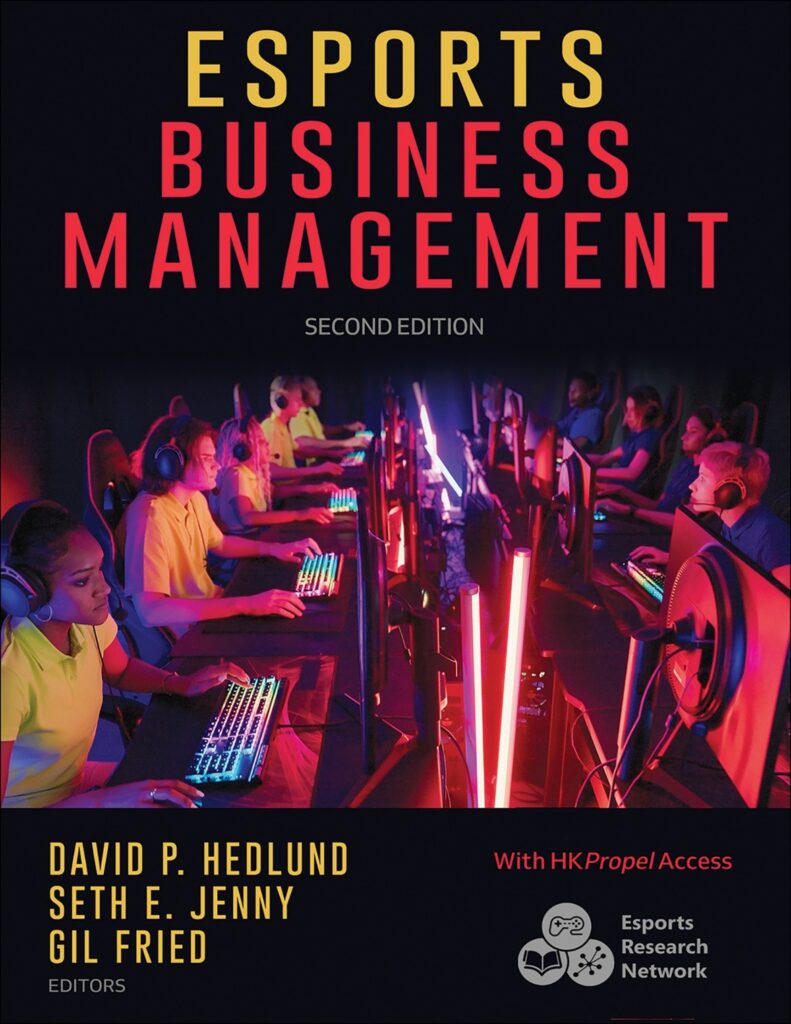
The second edition of the world’s best-selling esports textbook was recently published – Esports Business Management (2nd edition) with publisher Human Kinetics. The editors of this second edition are David P. Hedlund, Seth E. Jenny, and Gil Fried. The purpose of this article is to offer an overview of this text for interested readers and provide ideas to instructors who may require this text within their academic course.
Book’s Purpose
The purpose of Esports Business Management (2nd edition) is to provide a comprehensive, interdisciplinary, and applied examination of the global esports industry from a business and management perspective. This text is designed to equip students, scholars, and practitioners with a foundational understanding of esports as an ecosystem, while also developing the practical knowledge and critical thinking skills necessary to operate, manage, and lead within the rapidly evolving esports landscape. By integrating industry structure, culture, governance, marketing, sponsorship, venues, events, media, finance, law, team and player management, and career pathways, the book bridges theory and practice to prepare readers for informed decision-making and professional engagement across amateur, scholastic, semi-professional, and professional levels of esports.
Outline, Authors, and Contents
Foreword
by Julia Hiltscher, PhD
Chapter 1. Introduction to Esports
by David P. Hedlund, Seth E. Jenny, Gil Fried, and Russell Hamer
- What Is Esports?
- A Brief History of Video Games and Esports
- Esports Platforms
- Types of Esports Games
- The Esports Ecosystem
- Esports Industry Statistics and Market Research
Chapter 2. Levels of Esports
by Seth E. Jenny and Benjamin T. Sharpe
- Levels of Esports
- Pathways to Professional Esports
- Amateur Esports (Tier 3)
- Semi-Professional Esports (Tier 2)
- The Esports Pipeline Problem
- Professional Esports (Tier 1)
Chapter 3. Esports Culture and Issues
by Seth E. Jenny and Lindsey Darvin
- Perspectives of Gaming Based on Culture
- Potential Positive Impacts of Gaming
- Common Areas of Concern Regarding Gaming and Esports
Chapter 4. Esports Stakeholders
by Seth E. Jenny, Josh Jarrett, and Gil Fried
- Tier 1 Foundational Stakeholders
- Tier 2 Supporting Stakeholders
Chapter 5. Esports Governance
by Gil Fried and Clint Kennedy
- Defining Governance
- Types of Governance
- International Esports Federation (IESF)
- Global Esports Federation (GEF)
- International Olympic Committee and Esports
- United States Esports Federation (USEF)
- Collegiate Organizations
- High School Organizations
- Should Esports Be Governed the Way Sport Is Governed?
Chapter 6. Esports Marketing, Consumer Behavior, and Monetization
by David P. Hedlund and Marcus Howard
- The Five Ps of Esports Marketing
- Unique Aspects of Esports Marketing
- Marketing Esports to Players, Spectators, and Fans
- Spectator Motivations to Watch Esports
- Esports Sales and Monetization
Chapter 7. Esports Sponsorship
by David P. Hedlund and Anthony D. Pizzo
- Understanding Sponsorship
- Types of Esports Sponsors
- Sponsorship Opportunities
- Issues Facing Sponsors
- Sponsorship Evaluation
Chapter 8. Esports Venues
by Gil Fried
- Large-Scale Esports Venues
- Small-Scale Esports Venues
- Designing Esports Spaces for Universities and Athletes of the Future
- Basics of Esports Facility Management
Chapter 9. Esports Events
by Gil Fried and David P. Hedlund
- Brainstorming and Setting Goals and Objectives
- Creating the Framework of the Event
- Event Bidding
- Event Budgeting
- Event Registration
- Event Management
- Postevent Evaluation
- Thanking Patrons and Participants
Chapter 10. Esports Broadcast Management and Communications
by Seth E. Jenny, Adam Antor, Brandon C. Harris, and David P. Hedlund
- Media Production in Esports
- Tools in Esports Communication
Chapter 11. Esports Finance and Economics
by Gil Fried
- The Business of Esports
- Basic Financial Concepts
- Budgeting for an Esports Team
- How to Read an Annual Report
Chapter 12. Esports Law
by Gil Fried and Justin M. Jacobson
- What Is Esports Law?
- Overview of Important Legal Concepts
- Intellectual Property (IP)
- Contract Law
- Tort Liability
- Unionizing Esports Players
- Legal Rights of Esports Athletes
Chapter 13. Esports Team and Player Management
by David P. Hedlund, Seth E. Jenny, Joanne Donoghue, and Oliver Leis
- The Rise of Esports Coaching
- Esports Coaching as a Profession
- The Role of Owners, Game Coaches, and Life Coaches
- Health and Wellness Considerations
Chapter 14. Esports Careers
by Tobias M. Scholz, Nicolas Besombes, and David P. Hedlund
- Esports Job Descriptions and Résumés
- Careers in Esports
- Career Opportunities Outside of Esports and the Video Game Industry
- The Future of Esports
Contents and Organization
“The contents and organization of the second edition of this textbook consider all the most important aspects of the business and management of esports. We start our journey with a foreword from Dr. Julia Hiltscher about the importance of esports and business. From there, chapter 1 dives right into an introduction to esports and the industry, including some history and an examination of what we mean by esports, the esports ecosystem, platforms and types of games, and industry statistics. Chapter 2 provides a discussion of four levels of esports (youth, high school, college, and professional). Chapter 3 includes information about and comparisons of esports culture and issues from different perspectives, both positive and negative. Chapter 4 provides a framework of tiered stakeholders and thoroughly describes and discusses each group. Chapter 5 offers perspectives and information about the governance and organization of esports in various contexts.
The next seven chapters share in-depth information about key areas of the esports industry. Chapter 6 explores esports marketing and consumer behavior, including both how it is done and to whom it is targeted. This chapter also includes new information about monetization and new technology used by esports and related organizations. Because of its modern-day importance to the bottom line of many organizations in the industry, esports sponsorship (and related opportunities, issues, and evaluation) is examined in chapter 7. Face-to-face (in-person) events are held in any number of possible locations, and esports venues and facilities are discussed in chapter 8. Chapter 9 describes and discusses the creation, execution, and evaluation of esports events. Chapter 10 focuses on the production and the broadcasting and communications surrounding esports events. Underpinning all these business functions and activities is money; as a result, chapter 11 discusses the essentials of esports finance and economics. Because of the importance of numerous legal issues facing the industry, its organization, and its growth, chapter 12 provides information about esports and the law.
The final two chapters explore opportunities in the esports industry. Chapter 13 examines and discusses the management of esports teams and players from multiple perspectives. Chapter 14 surveys the esports industry landscape and focuses particularly on jobs and careers in the industry, all while being mindful that the industry is changing at a rapid pace and new knowledge and skills may be required in the near future” (p. xiv).
Esports Research Network (ERN) Endorsement
This text is endorsed by the ERN and includes several authors and editors who are active ERN members. As Tobias M. Scholz, co-founder and acting chairperson of the Esports Research Network, has noted: “The second edition of Esports Business Management continues to lay the vital foundation for teaching esports business management. It is a must-read for anybody to level up in their esports knowledge, skills, and abilities” (p. iii).
Instructor and Student Resources
The instructor and student resources that accompany this book are available in HKPropel. Resources provide instructors with support to implement learning activities in the classroom, and include:
- Instructor guide
- Chapter objectives
- Key terms highlighted and defined within each chapter
- “Zoning” sidebars within each chapter
- Chapter discussion questions
- Test package and chapter quizzes
- PowerPoint presentation package for each chapter
- Student exercises (2-4 per chapter)
- Recommended online videos for each chapter’s content
- Full access to related Journal of Electronic Gaming and Esports (JEGE) chapter-related articles
The student resource also includes a website dedicated to selected full-text open access articles from the Journal of Electronic Gaming and Esports (JEGE), along with recommended assignments to supplement those articles. Internet resources and student assignments reinforce the concepts discussed in the chapters.
Ideas for Instructors
This text makes an excellent required text for an “Introduction to Esports” module/course. As there are 14 chapters, covering one chapter per week for a 15-week semester aligns nicely, or covering two chapters per week for an 8-week term. When the first and second editions of Esports Business Management were developed, a thoughtful approach was taken to make it possible for professors and educators to use (and reuse) the book and its contents.
Each chapter is designed to be a standalone resource. While there are connections that run throughout the book, for the most part, each chapter can be used independently. The editors and authors are well-aware that there are few resources available for those teaching esports-focused classes, so it was intentional to make the textbook a resource that can be reused and referred to in other classes. For instance, if an academic program uses the text in an “Introduction to Esports” class, chapters of the book could also be reused in other classes as the introductory reading in other esports classes. Moreover, if an educational institution also teaches an “Esports Marketing” class, Chapter 6 (Esports Marketing, Consumer Behavior, and Monetization) of Esports Business Management can be assigned as the introductory reading in that class, and then additional resources and ancillaries (e.g., case studies) provided to faculty who use the book can be used in the classroom. The same goes for all 14 chapters in Esports Business Management. Each chapter provides a comprehensive overview of the topic. Additionally, the ancillary resources, offered to educators who require the textbook in their course, provide chapter PowerPoints, case studies, additional resources, teaching ideas, discussion questions, quizzes and tests, and much more. For advanced classes or graduate-level courses, the editors and authors provide links and connections to open-access articles from the Journal of Electronic Gaming and Esports. These articles provide opportunities for educators and students to delve deeper into cutting-edge ideas and research on topics related to the contents of the textbook.
More Information (and Review Copy Request for Instructors)
See the textbook’s official website for more Information about this text, along with a link for instructors to request a “review copy” for course adoptions:
Instructors Might Utilize “Inclusive Access”
Instructors can consider requiring the text with “inclusive access”, which is digital access to the electronic version of the book (i.e., eBook). With inclusive access, students are charged the lowest possible price for the book directly to their tuition and can “opt out” within the first week of class if they do not want to purchase it through inclusive access (depending on the institution’s policies). Instructors should speak to their institution’s bookstore representative or librarian about inclusive access. Beyond the benefit of the students getting the book for the lowest price possible, a benefit for instructors is that students have access to the book from the first day of class, so students cannot complain about not being able to do the first assignment or reading because they do not have the book yet. Click here to more about inclusive access.
Attaining the Book via Institutional Library
Anyone can also ask their local or institutional library to acquire the book. A campus library may provide the text to students as both a physical work and an online resource via their website.
Conclusion
The second edition of Esports Business Management is designed to continue to provide a comprehensive overview of the esports industry, how it operates, and important information about essential business and management functions. Due to the uniqueness of the esports industry and its ever-evolving activities, there continues to be an important need for dedicated up-to-date resources focused on the business and management of esports. Esports Business Management (second edition) is a must-read for all students, instructors, and esports practitioners.
About the Article Authors
Seth E. Jenny, Ph.D., teaches esports courses within the Department of Exercise Science at Slippery Rock University of Pennsylvania. He is the Senior Editor of the Routledge Handbook of Esports, Co-editor of Esports Business Management (2nd edition), Associate Editor of the Journal of Electronic Gaming and Esports, Series Editor of the Routledge Research Series in Esports and Video Gaming, and Board Member of the Esports Research Network.
David P. Hedlund, Ph.D., is the chairperson of the division of sport management at St. John’s University, where he is also a faculty expert and faculty leader on research and topics related to esports. Dr. Hedlund earned his PhD in sport management and a certificate in measurement and statistics from Florida State University. He has more than 20 years of domestic and international experience in sports, esports, coaching, business, education, and analytics. He has published more than 60 journal articles and book chapters on related topics. Dr. Hedlund is the Chief Editor of the Journal of Electronic Gaming and Esports (JEGE) and lead editor of Esports Business Management (2nd edition). He has worked with the International Esports Federation, the United States Esports Federation, and the Esports Research Network. In recent years, Dr. Hedlund has also acted as a consultant for dozens of domestic and international high school, college, and professional esports teams as well as business and entrepreneurial ventures, including speaking at the World Cyber Games and the Global Esports Executive Summit.